

Denver's Real Estate Market Isn't One Market — It's at Least Three
If you've been watching the Denver real estate headlines lately, you've probably noticed they seem to contradict each other. One story says it's competitive out there. Another says buyers have the upper hand. Both are true — just in different neighborhoods. What we're seeing right now in metro Denver is very much a divided market, and understanding which bucket your home or your search falls into makes all the difference.
Group 1: Move fast or move on
In well-established neighborhoods with limited inventory and steady demand, properly priced and well-prepared single-family homes are still selling quickly and cleanly. We're talking about areas like Applewood, Littleton, Congress Park, Wellshire/Southern Hills, and Berkeley — neighborhoods with character, walkability, strong schools, or some combination of all three that buyers keep coming back to.
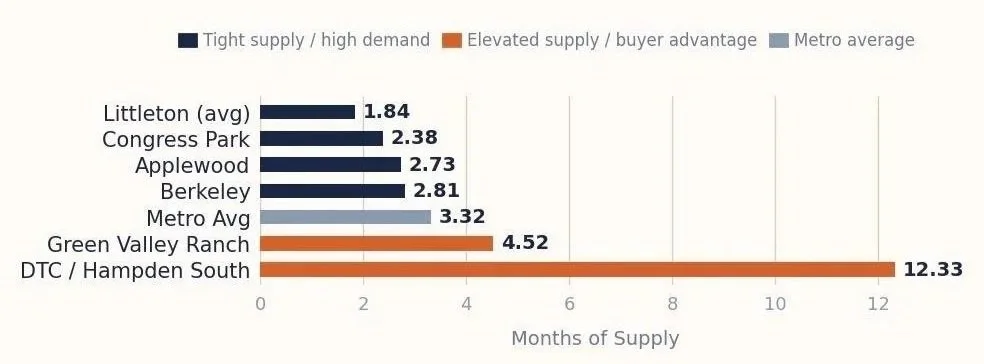
The data backs this up. In Applewood (80215), 72.7% of homes went under contract within 7 days last month. Littleton zip codes 80120 and 80122 are showing a predictive Months of Supply under 1.5 — meaning inventory is tightening, not loosening. Berkeley (80212) has a predictive MSI of 2.11, trending well below the metro average of 3.09. Congress Park (80206) is seeing price reductions below the metro average, with inventory that continues to shrink.
In these neighborhoods, preparation and pricing still matter enormously — but sellers who get those two things right are being rewarded.
Group 2: Buyers have room to breathe
Not every neighborhood is telling that story. In areas like the DTC/Hampden South corridor, Green Valley Ranch, and the higher price points in Hilltop, the dynamic is quite different. The DTC area (80237) currently has a Months of Supply of 12.33 — more than three times the metro average — with 66.7% of active listings having already reduced their price. Green Valley Ranch (80019) has a predictive MSI of 6.38 and only 2.1% of homes going under contract within 7 days. And in Hilltop, higher-priced homes are averaging over 74 days on market, with active inventory continuing to build. Buyers in these areas have time, options, and negotiating room.
Group 3: Condos across the board
Regardless of neighborhood, the condo market is its own story right now, and it's a buyer's story. Between higher HOA fees, insurance challenges, and buyers who have more options than they did a few years ago, condos metro-wide are sitting longer and selling for less relative to original list price. If you're a condo buyer, this is one of the better windows of opportunity we've seen in a while. If you're a condo seller, pricing with the current market — not the market of 2021 — is essential.
What this means for you
The metro Denver average — 3.32 months of supply, 35.4% odds of selling, 44.1% of homes with a price reduction — doesn't describe any of these three realities very well. It's a blend of all of three of them. Looking at the ultra-luxury market, there’s even more nuance as it is typically less influenced by interest rates but still impacted by markets and overall investment strategies. That's why I spend a lot of time looking at the data at the zip code level before advising any client on price, timing, or strategy.
» Want to know more about your current or target neighborhood? Whether you're buying, selling, or just keeping an eye on the market, I'm always happy to talk through what the numbers mean for your specific situation. Reach out anytime — this is exactly the kind of thing I love to dig into. «
Months of Supply by Neighborhood
If you're in the market to buy/sell a home, or you just want to chat about real estate, let’s connect! I’m happy to share market resources, vendor referrals or anything else that would be helpful in your journey.